
Krupa Market - How the Water Cement Ratio Influences Concrete Workability and Strength

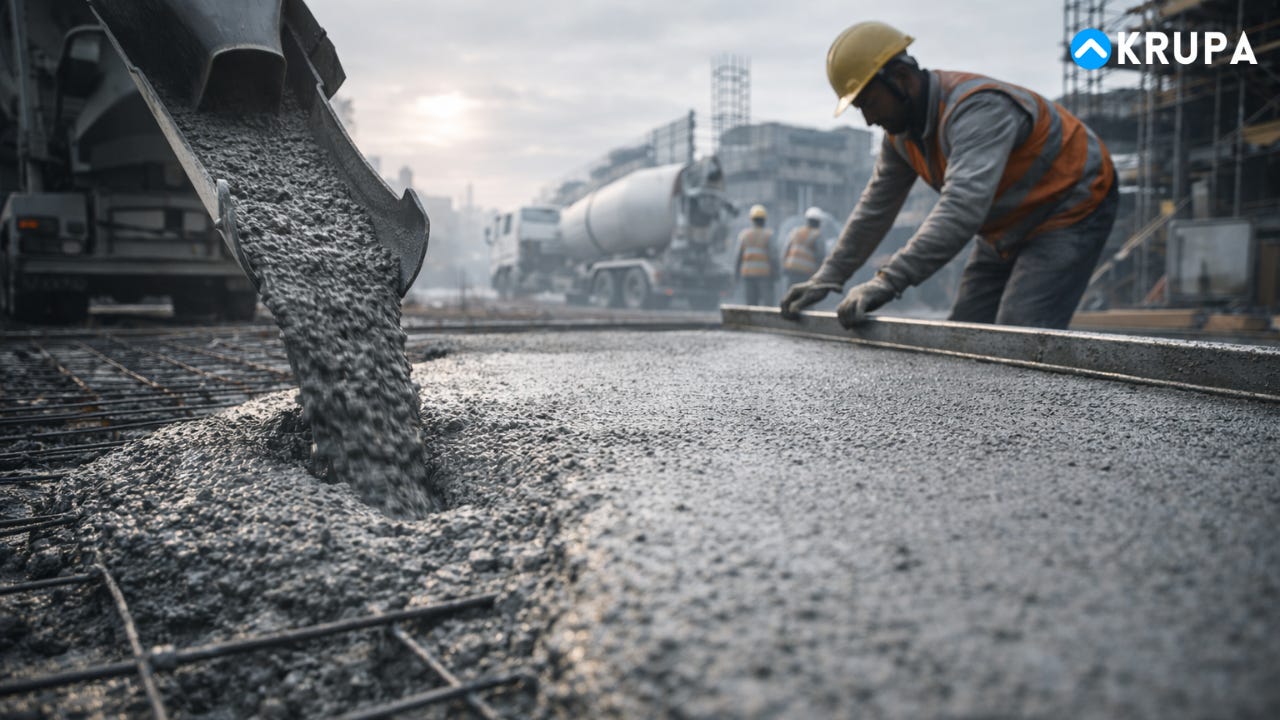
The water cement ratio is one of the most important factors in concrete mix design. It directly affects how easily concrete can be handled during construction and how strong and durable it becomes after hardening. Understanding this balance is essential for producing concrete that performs well on site and over its service life.
In simple terms, the water cement ratio represents the amount of water used compared to the amount of cement in a concrete mix. Even small changes in this ratio can significantly alter the behavior and performance of concrete.
Effect of Water Cement Ratio on Workability
Workability describes how easily fresh concrete can be mixed, transported, placed, compacted, and finished without segregation.
Higher water cement ratio
When more water is added to the mix, concrete becomes more fluid and easier to work with. This improved flow helps during placement, especially in areas with dense reinforcement or complex formwork. Finishing operations also become simpler, reducing the effort required on site.
However, excessive water can lead to bleeding and segregation, which negatively affects surface quality and long-term performance.
Lower water cement ratio
Reducing the water content makes concrete stiffer and harder to handle. While this can improve quality, poor workability may cause difficulties during placement and compaction. If not managed properly, it can result in voids, honeycombing, or incomplete filling of formwork.
To address this, construction teams often rely on proper compaction methods or chemical admixtures to improve flow without adding extra water.
Effect of Water Cement Ratio on Strength
Concrete strength, particularly compressive strength, is highly sensitive to the amount of water used in the mix.
Higher water cement ratio
Although higher water content improves workability, it reduces strength. As concrete hardens, excess water evaporates and leaves behind microscopic pores. These voids weaken the internal structure of concrete, lowering compressive strength and reducing durability.
Concrete with too much water is also more vulnerable to cracking, permeability, and long-term deterioration.
Lower water cement ratio
A lower water cement ratio produces denser concrete with fewer pores. This results in stronger bonding between cement paste and aggregates, leading to higher compressive strength and improved durability. Such concrete performs better under load and offers greater resistance to environmental exposure.
Achieving the Right Balance
Selecting the correct water cement ratio is a balance between ease of construction and structural performance:
For high-strength and durable concrete, a lower water cement ratio is preferred. To maintain workability, plasticisers or superplasticisers are often used.
For applications where ease of placement is critical, a slightly higher ratio may be acceptable, provided strength requirements are still met.
The key is to avoid adding excess water at the site, as this can severely compromise the quality of concrete.
Conclusion
The water cement ratio plays a decisive role in determining both the workability and strength of concrete. While more water improves handling, it weakens the final structure. Less water enhances strength but demands better mix design and execution.
By carefully controlling this ratio and using appropriate admixtures and construction practices, builders can produce concrete that is easy to work with while meeting strength and durability requirements.